Agricultural stretch film for round bales and square bales
All the Facts at a Glance
Agriculture faces numerous challenges today: From extreme weather conditions to pest infestations and rising production costs. In this complex environment, farmers are constantly looking for efficient solutions to protect their yields while minimizing costs. One method that is often underestimated but extremely effective is the use of agricultural stretch film.
What are agricultural stretch films?
Agricultural stretch films, also known as silage films, wrapping films, net replacement films, or wide films, are special plastic films used in agriculture. These films are typically made of polyethylene (PE), a material known for its high flexibility, tear resistance, and weather resistance. Thanks to their elasticity, agricultural stretch films can be wrapped tightly around agricultural products, creating a virtually airtight seal. These properties make them particularly effective for silage production and the storage of agricultural products.
What is wrapping film used for in the agricultural sector?
In agriculture, wrapping film is mainly used to preserve animal feed and protect it from external influences. But the possible applications are more diverse than you might think. From reducing harvest losses to improving storage life — the benefits of this special stretch film are wide-ranging.
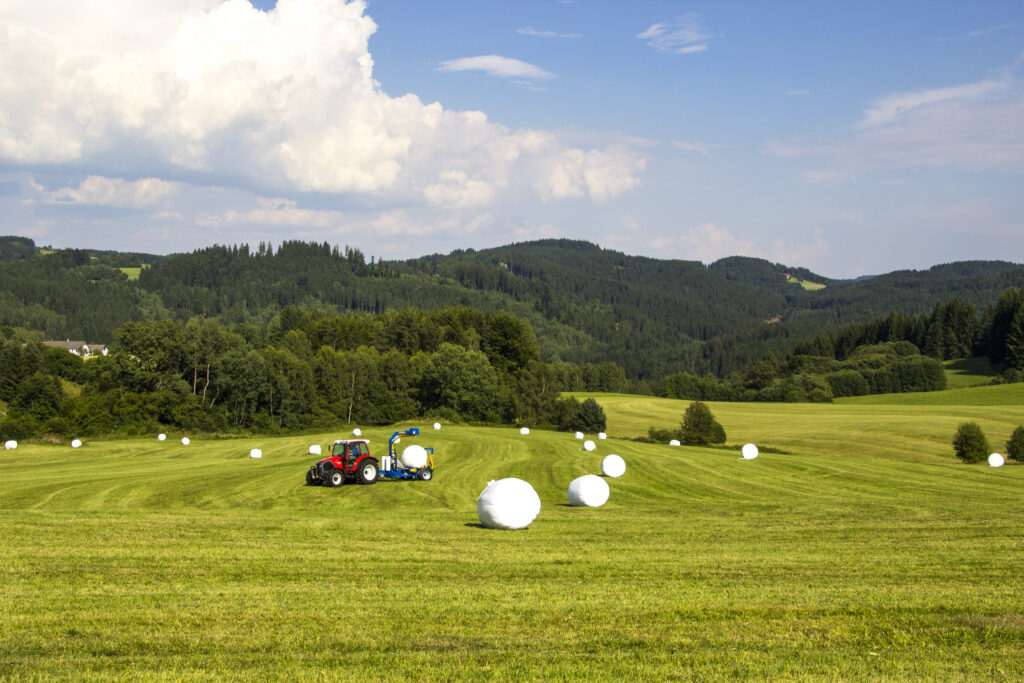
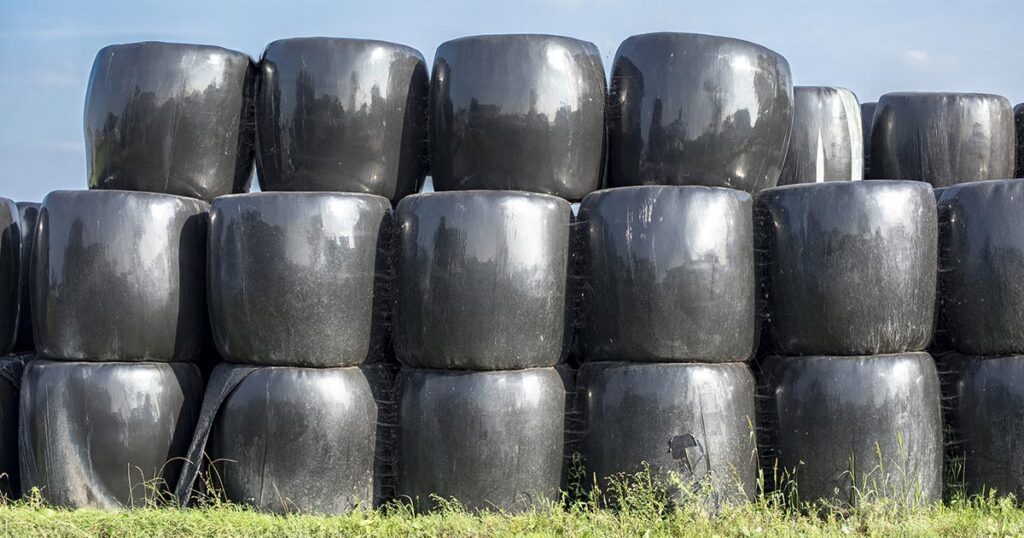
The harvested crop, pressed into round or square bales, is sealed airtight with film right in the field using overlapping wrapping. This creates the conditions for successful ensiling. This process occurs only under low-oxygen conditions and converts carbohydrates into lactic acid, which acts as a preservative.
Film binding with GÖWEIL
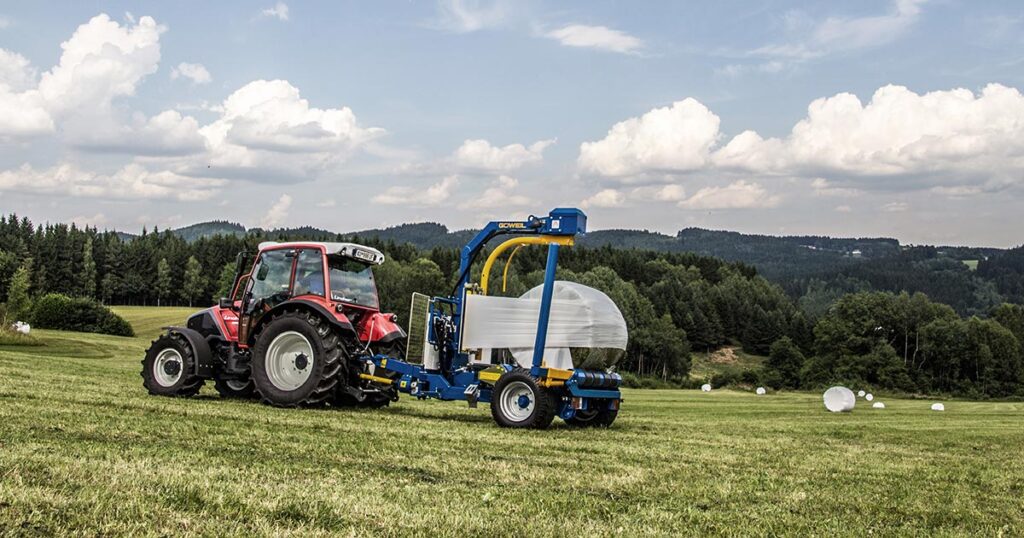
The G-1 F125 Kombi and the LT-Master are equipped with a film binding system as standard. A dual binding unit is available as an option, which allows users to switch between net and agricultural stretch film depending on their needs, or to cut the binding time in half by loading two rolls of film.
If the wrapping film is wide enough, it wraps around the edges of the bale and encloses them, providing additional protection against mechanical damage. It also ensures dimensional stability, so that the bale expands less after baling. In addition, when the bales are cut open and fed to animals, only one type of waste is produced—consisting of wrapping film and wide film—which simplifies disposal and recycling.
Our sales team will be happy to answer any further questions you may have about using agricultural stretch film in GÖWEIL balers and wrapping machines.
What is agricultural stretch film made of?
The stretch film commonly used for silage is made of polyethylene, the most widely used plastic in the world. The raw material used to produce polyethylene is ethylene – a gas derived from crude oil and natural gas.
Polyethylene comes in various types with different densities and corresponding material properties. It is used in a wide variety of packaging. But bags, films, containers for beverages, cleaning products, and cosmetics, as well as interior coatings and cable sheaths, are also usually made of polyethylene.
Film width, roll length, film thickness, and weight of the wrapping film
An Overview of Facts About Agricultural Stretch Film
- Width: 250 to 750 mm roll width
- Roll length: 1,500 m to 2,200 m
- Thickness: 19 to 25 µm
- Weight: Provides insight into quality
Width: Agricultural stretch film with a standard width of 750 mm
The standard width for wrapping film rolls today—and the standard for all GÖWEIL wrappers for round bales and square bales—is 750 mm (75 cm). Older wrapping machines from other manufacturers also use stretch film that is 500 mm (50 cm) wide. Narrower film widths of 250 mm, 360 mm, or 375 mm are used only for so-called mini round bales.
Length: Roll lengths of 1,500 m or more
For farmers, the length of the film is generally not a major concern. Agricultural stretch film with a width of 750 mm is usually supplied in rolls with a length of 1,500 m. However, longer roll lengths of 1,650 m or 2,000 m are also available. Stretch film with roll lengths between 1,500 m and 2,200 m is commercially available. Stretch film with a width of 500 mm is usually available in a roll length of 1,800 m.
Thickness: Thinner films with equivalent properties
Film thickness is specified in micrometers (µm); one µm is equivalent to 0.001 mm. Wrapping films are generally available in thicknesses ranging from 19 to 25 µm.
Stretch film with a thickness of 25 µm can be used for a wide range of applications. High-quality, reduced-thickness films of 19–22 µm generally offer equivalent properties in terms of stretchability, puncture resistance, and oxygen permeability. Because these films are thinner, the rolls generally have a greater roll length. Fewer roll changes can therefore result in time savings compared with standard-thickness films.
Weight: How to assess quality
The weight of the film rolls provides an indication of their quality. As a general rule, film rolls should have the following weights:
| Width | Length | Weight |
| 500 mm | 1,800 m | approx. 22.20 kg |
| 750 mm | 1,500 m | approx. 28.00 kg |
A difference of up to 5% is possible.
Tip: To help you choose between the many film manufacturers, try comparing rolls of the same thickness, roll length, and width.
What Color Should Agricultural Stretch Film Be?
Films are most commonly used in green, black, or white. Some manufacturers offer transparent films, making it easy to see what type of crop is contained in the round or square bale. Fermentation problems caused by damage or inadequate ensiling are also immediately visible.
Wrapping films are now available in other colors, such as blue, yellow, pink, and purple. In warm regions, lighter colors are preferable because bales wrapped in light-colored film do not heat up as much in strong sunlight as bales wrapped in dark film, thereby reducing the risk of nutrient loss.
Tips for Use – What Should You Keep in Mind When Using Agricultural Stretch Film?
- The adhesive responsible for bonding the individual film layers is “activated” by pre-stretching (stretching) the film. It is common practice to pre-stretch the stretch film by 60–70%. More extensive stretching is not recommended because it causes the film to narrow (necking) and results in less overlap due to the narrower film strips.
- Regular cleaning of the pre-stretch rollers helps ensure a smooth workflow.
- Of course, you should only use undamaged rolls of film.
- It is best to remove any packaging from the agricultural stretch film immediately before use.
- Also, make sure the blades have precise settings and that the film webs are cut cleanly.
- At high outdoor temperatures, film tears may occur more frequently, since the film’s elasticity and tear resistance depend on temperature. Wrapping in rainy conditions can also adversely affect the adhesion of the individual film layers.
How Many Layers of Film Should Be Used for Wrapping?
With regard to the number of film layers, nearly all film manufacturers recommend six layers of film as the standard. Since polyethylene is not 100% gas-tight, multiple layers of overlap to ensure feed quality are essential for proper feed preservation. Field forage such as alfalfa, clover, or ryegrass should, depending on its dry matter content and crop structure, preferably be wrapped with 8–10 layers of film. The greater number of layers of wrapping film prevents the coarser and sturdier parts of the plants from piercing through and provides greater protection for the preservation of the valuable forage.
Storing Stretch Film Properly
To ensure the durability and effectiveness of stretch film, proper storage is essential. Stretch film should be stored in a cool, dry place protected from direct sunlight. Extreme temperatures and high humidity can affect the film’s material properties and lead to premature wear. Horizontal storage on clean, level surfaces prevents deformation and damage to the rolls. In addition, the film should be protected from mechanical stress and sharp objects to prevent cracks and other damage. By following these storage instructions, the agricultural stretch film will remain in optimal condition for a long time and provide reliable performance.
Everything you need to know about properly storing agricultural stretch film!
Disposal and Recycling of Silage Film
Here you will find an overview of disposal and recycling options for agricultural stretch films as well as biodegradable alternatives:
Everything you need to know about recycling agricultural stretch film!


